Implementing Effective Recall Commands for Dogs Enjoying Summer Park Visits
Understanding the Importance of a Reliable Recall in Summer Environments
Safety First: Preventing Incidents in Busy Parks
Picture this: a beautiful summer day, the sun is shining, and you’re at the park with your furry best friend. It sounds idyllic, right? But what happens when your dog spots a squirrel, another dog, or even a child with a dropped ice cream cone, and takes off like a rocket?
Without a rock-solid recall, those picturesque moments can quickly escalate into stressful, or even dangerous, situations. This is especially true during the summer months when parks are bustling with activity.
A reliable recall isn’t just about convenience; it’s a critical safety measure. Consider the sheer number of potential hazards in a busy park: bicycles, skateboards, cars (if near a street), other dogs with varying temperaments, and young children who might not understand how to interact with an excited canine. Your dog darting into any one of these scenarios without immediate intervention can lead to injury, lost pets, or even liability issues. Therefore, investing time in dog training, specifically mastering the recall, becomes paramount for responsible pet ownership.
Think about the peace of mind it brings. When you know your dog will come back to you no matter the distraction, you can both enjoy off-leash areas with confidence. This foundational skill allows you to prevent your dog from sniffing something harmful, chasing wildlife, or inadvertently frightening someone. It’s truly a cornerstone of responsible pet ownership, much like understanding the benefits more broadly. Without it, you’re constantly playing a game of “what if,” which takes away from the joy of shared outdoor adventures.
The Lure of Summer Distractions: Why Parks are Different
Summer parks are a sensory explosion for dogs, presenting a unique challenge to even well-behaved canines. Unlike a quiet backyard or a familiar neighborhood walk, parks during warmer months are alive with sights, sounds, and smells that can be incredibly distracting. We’re talking about picnics (oh, the dropped crumbs!), children playing noisy games, other dogs engaging in high-energy play, and an abundance of novel scents from new vegetation and various visitors.
These intense environmental stimuli can easily overwhelm a dog’s focus. A perfectly executed recall in your living room might completely fall apart when faced with the irresistible aroma of a discarded hot dog bun or the exciting chase of a frisbee-throwing group. This is precisely why training a reliable recall for a summer park environment requires specific attention to distraction proofing. It’s not just about teaching the command; it’s about solidifying it against real-world temptations that are amplified during peak park season.
Furthermore, the general hubbub often means increased noise levels and unpredictable movements, both of which can either excite your dog to the point of ignoring you or, conversely, make them anxious and harder to reach. Understanding these amplified distractions is key to setting realistic training goals and preparing your dog effectively. It really highlights the importance of comprehensive distraction dog training, especially for those highly stimulating environments.
Ultimately, a strong recall allows you to navigate these situations gracefully, ensuring both your dog’s safety and the comfort of other park-goers. Without it, you might find yourself constantly on edge, unable to relax and truly enjoy the experience. The aim is for your ‘come’ command to be more compelling than any squirrel, scent, or sound the park throws your way.
Building Owner Confidence for Off-Leash Enjoyment
Let’s be honest, few things are more unsettling for a dog owner than calling their dog repeatedly, only to be ignored as the dog continues its merry way, oblivious to your pleas. This lack of control can erode an owner’s confidence, leading them to avoid off-leash opportunities altogether. And that’s a shame, because off-leash time is incredibly beneficial for a dog’s physical and mental well-being, offering freedom, exercise, and enrichment that leashed walks simply can’t provide. Many owners find themselves grappling with this very issue, wondering dog training. what when it comes to the trickier aspects like recall.
A truly reliable recall command empowers you as the owner. It gives you the confidence to let your dog explore, knowing that you can call them back to your side instantly if needed. This isn’t about stifling your dog’s fun; it’s about creating a safe framework within which they can enjoy maximum freedom. When you’re confident in your dog’s ability to respond, you become more relaxed, and that calmness often transfers to your dog, making the entire park experience more enjoyable for both of you.
Moreover, building this confidence through effective recall training fosters a stronger bond between you and your dog. It reinforces that you are the reliable leader, the source of safety and good things, even amidst exciting distractions. This mutual trust is invaluable. Owners who have successfully trained a solid recall often describe a feeling of liberation, no longer dreading every off-leash encounter. They can confidently visit new parks and trails, knowing their dog will return. This is where mastering 5 essential commands, and the recall specifically, truly shines.
So, if you’ve been hesitant about allowing your dog off-leash in summer parks due to concerns about their responsiveness, now is the time to commit to perfecting that recall. It’s an investment that pays dividends in safety, freedom, and enjoyment for years to come.
Are you ready to transform those anxious park visits into joyful outings? Understanding the ‘why’ behind a strong recall is the first step; the next is diving into the practical ‘how-to’.
Foundational Steps for Building a Strong Recall
Starting Strong: Positive Reinforcement Basics
Building a reliable recall, especially for those exciting summer park visits, hinges entirely on positive reinforcement. Your dog needs to associate coming back to you with something incredibly rewarding. This isn’t about punishment for not coming, but rather celebrating enthusiastically when they do. Think about it: if coming to you means the fun stops, why would they bother?
So, how do we make it irresistible? Start with high-value rewards – what really gets your dog’s tail wagging? Is it a special treat they only get for recall?
A favorite squeaky toy? Or perhaps some enthusiastic belly rubs that make them melt? Consistency here is key.
Every single time your dog responds to their recall cue, even if they were only a few feet away, they should receive a reward. This instant gratification reinforces the desired behavior. Remember, the goal is to make returning to you the absolute best thing that could happen at that moment.
Without this strong positive association, you’re fighting an uphill battle against all the enticing smells and sights at the park.
And when we talk about dog training, the foundation truly lies in making learning a joyful experience. If your dog enjoys the process, they’re much more likely to master commands and retain them under pressure. This positive foundation is critical, particularly when developing a behavior as vital as an off-leash recall.
Choosing Your Recall Cue: Clarity and Consistency
Selecting the right recall cue and using it with absolute consistency is paramount. Think of it as your dog’s personal, urgent summons – it needs to be unique and unambiguous. Popular choices include “Come!” “Here!” or even a distinct whistle.
Whatever you choose, ensure it’s not something you use casually in other contexts. This helps prevent “cue dilution,” where your dog learns that the sound doesn’t always mean “return immediately.”
The tone of your voice matters just as much as the word itself. It should be upbeat, enthusiastic, and inviting – never angry or frustrated, even if your dog took a moment to respond. If you sound frustrated, your dog might associate the cue with a negative experience, making them less likely to come next time.
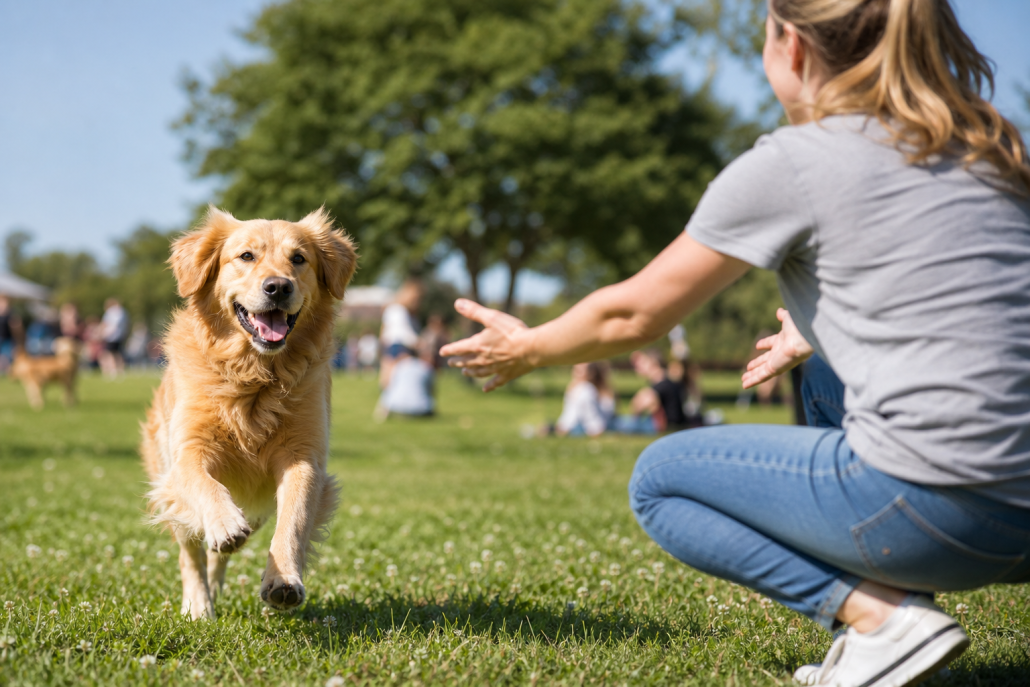
Practice saying your chosen cue with the same inflection every time. Your body language also plays a significant role; crouch down, open your arms, and make yourself look approachable and exciting. Avoid standing stiffly or appearing confrontational.
This combination of a clear vocal cue, an inviting tone, and welcoming body language sends a unified, positive message to your dog.
We often emphasize the importance of distinct cues in our foundation training. program, because without that clarity, dogs can get confused, leading to slower responses or no response at all.
Gradual Progression: From Quiet Spaces to More Stimulating Areas
You wouldn’t expect a toddler to run a marathon after their first steps, right? The same logic applies to dog recall training. Beginning your recall practice in a quiet, distraction-free environment is crucial.
Your living room, a securely fenced backyard, or a very calm park during off-peak hours are ideal starting points. Here, your dog can focus solely on you and the cue without the overwhelming temptations of other dogs, squirrels, or tantalizing smells.
Once your dog reliably responds in these low-distraction settings (meaning they come to you 90-100% of the time), you can gradually introduce more challenging environments. This is a slow, methodical process. Your next step might be a slightly busier park, but perhaps still on a long training line for safety. The key is to increase distractions incrementally. If your dog struggles, it means you’ve introduced too many distractions too quickly, and you need to regress to a simpler environment. Avoid the common are you making, one of which is expecting too much too soon.
For example, start with a park when it’s nearly empty, then move to a time with a few other walkers, then perhaps one or two other dogs in the distance. This systematic approach builds your dog’s confidence and solidifies their understanding of the recall cue, no matter what captivating scents or sights are around them.
Proofing the Recall: Practicing with Controlled Distractions
Proofing the recall Defined Key Terms: This is the process of practicing your recall command in increasingly distracting environments to ensure your dog responds reliably under any circumstances. This stage is where all your hard work from the previous steps comes together. Summer parks are bursting with distractions: children playing, other dogs romping, picnics, and countless new smells. Your recall needs to be strong enough to cut through all of it.
Begin by setting up controlled distractions. Ask a friend to walk past with their dog at a distance, or have someone gently toss a toy away from your dog as you give the recall cue. Use a long training line at first – this provides a safety net and allows you to gently guide your dog if they get “stuck” on a distraction.
Each successful recall in the face of a distraction should be met with an even higher-value reward and immense praise. The goal is to teach your dog that YOU are more interesting and rewarding than any squirrel or another dog they might encounter.
As their reliability grows, you can gradually increase the intensity and nature of the distractions, moving towards scenarios more akin to what you’d find in a busy summer park. Never forget that consistency is your superpower here. Every successful recall, even when assisted by the long line or a verbal nudge, builds the habit. This methodical proofing process is what truly cements an the all-important recall as a reliable, life-saving skill, ensuring enjoyable and safe park experiences for both you and your canine companion.
Addressing Common Challenges in Park Settings
Overcoming Environmental Temptations (Smells, Sights, Sounds)
Summer park visits, while fantastic for exercise and socialization, throw a wrench in even the best dog training efforts when it comes to recall. The sheer volume of novel stimuli can make your dog’s ears (and nose) practically deaf to your calls. Think about it: a squirrel darting across the path, the tantalizing scent of a dropped hot dog bun, the cheerful squeals of children playing, or even just another dog’s scent trail.
These are all incredibly powerful distractions. So, how do we compete with a squirrel’s allure? A foundational step is to progressively introduce these distractions during training, starting small and gradually increasing the intensity.
We teach our dogs to prioritize our voice over these sensory overload situations. For instance, begin by practicing recall in a quiet part of the park, then move to an area with minimal activity, and slowly build up to busier sections. And remember, high-value rewards are your best friend here.
That piece of jerky might just be more enticing than that distant interesting smell.
Managing Interactions with Other Dogs and People
One of the biggest hurdles in park recall is undoubtedly the presence of other dogs and people. Our furry companions are social creatures, and the urge to greet every wagging tail or friendly face can be overwhelming. This isn’t a bad thing in itself, but it can quickly derail your dog’s responsiveness. Consider the scenario: you call your dog, and they’re halfway to making a new friend. What do you do? The key is proactive management and training. Teach your dog a strong “leave it” command for distractions long before you hit the park. Furthermore, practice calling your dog back before they get too engaged with another dog or person. This means interrupting their focus when they first notice a potential interaction, not when they’re already mid-play. It’s about teaching them that coming to you, even when exciting things are happening, leads to an even better reward. Sometimes, if your dog truly struggles with these interactions, a specialized program like our board & train option can provide intensive, distraction-filled training in a structured environment.
The Role of Confidence-Building Games and Engagement
A dog that feels confident and engaged with you is far more likely to respond to a recall command, even in distracting park environments. This isn’t just about obedience; it’s about strengthening your bond and making you the most exciting thing in the park. So, what kind of games are we talking about?
Think about games like “hide and seek,” where you disappear behind a tree and call your dog, rewarding them enthusiastically when they find you. Or playing “fetch” with their favorite toy, making yourself the source of all the fun. These activities not only build confidence by allowing your dog to succeed but also increase their focus on you.
When you’re more engaging than a random sniff or a passing stranger, your recall automatically improves. Moreover, always remember to maintain a positive and upbeat tone when calling your dog. A stern, frustrated voice is far less inviting than a cheerful one, especially when they’re having the time of their life.
Troubleshooting: When Your Dog Ignores the Call
It happens to the best of us: you call, and your dog pretends not to hear you, or worse, gives you a quick glance and then bolts in the opposite direction. This can be frustrating, even embarrassing, but it’s a common challenge, especially in high-distraction areas like summer parks. If your dog consistently ignores your recall, it’s a clear sign that the command isn’t as reliable as it needs to be in that specific environment. First, avoid chasing your dog, as this can turn their refusal into a fun game for them. Instead, try running in the opposite direction, making exciting noises, or even dropping to the ground. These unexpected actions can pique their curiosity and often prompt them to come investigating. If the issue persists, go back to basics. Revisit your basic obedience dog in a lower-distraction environment. Sometimes, professional guidance might be necessary. An animal behavioral consultation can help identify underlying issues, or a structured boot camp can provide intensive retraining. Don’t get discouraged; every ignored call is an opportunity to re-evaluate and strengthen your approach to how to handle and other public settings.
Advanced Strategies for Rock-Solid Recall Reliability
Varying Rewards: Keeping Your Dog Engaged and Motivated
Once your dog has a solid grasp of the basic recall command, it’s crucial to understand that motivation isn’t a static thing. Just like us, dogs can get bored with the same old reward. To achieve truly reliable dog recall training, especially in stimulating environments like a summer park, you need to keep things fresh.
Think of it as a diversified investment portfolio for your dog’s motivation. What truly excites your dog? Is it a high-value treat, a squeaky toy, a quick game of tug, or even just some enthusiastic verbal praise and a good ear scratch?
The key is to cycle through these different rewards.
For example, one day you might use small pieces of cooked chicken (a universal favorite, let’s be honest), and the next, a particularly enticing tennis ball. This unpredictability keeps your dog guessing and, more importantly, keeps them eager to respond because they never know what amazing thing might be waiting for them. And speaking of amazing things, don’t forget the power of a quick, intense interaction. A 10-second burst of playtime with their favorite toy can be far more rewarding than a handful of dry kibble.
Remember, the goal isn’t just to get them to come back, but to make coming back the absolute best option available, even when there’s a squirrel taunting them from a tree. Are you genuinely making the recall experience a highlight for your summer park dog?
Emergency Recall: A Dedicated Safety Signal
Beyond your standard recall, every dog owner needs an emergency recall. This isn’t just a slightly louder “Fluffy, come!” – it’s a completely distinct, high-stakes command reserved exclusively for situations where your dog’s safety is at immediate risk. We’re talking about a sudden charge towards a busy road, an aggressive dog, or something equally dangerous. The defining characteristic of an emergency recall is that it is never used casually.
To establish an effective dog recall training emergency signal, you need a unique word or sound, something you rarely use otherwise. A sharp whistle, a specific word like “CODE RED” or “CRITICAL,” or even a series of claps. The training for this needs to be incredibly high-value and practiced in extremely controlled, low-distraction environments first.
Each successful emergency recall must be met with the absolute highest possible reward your dog can imagine – think an entire hot dog or a play session with their most coveted toy, not just a small treat. And importantly, it should only be practiced a few times a week, to maintain its special status and prevent habituation.
The principle here is clear: this command means “drop everything and get to me NOW for an amazing reward.” Your dog needs to associate that specific signal with an undeniable, immediate incentive. This dedicated safety signal is an essential tool for any pet owner, offering peace of mind when enjoying those summer park dog adventures.
The Power of Long Lines: Bridging the Gap to Freedom
A long line is an invaluable tool in dog recall training, acting as a crucial bridge between leashed walks and off-leash freedom. It allows you to gradually introduce your dog to more distractions in a summer park environment while still maintaining a measure of control. Think of it as a safety net that gives you the ability to intervene if your dog gets too distracted or starts to ignore your effective dog commands.
When starting with a long line (15 to 30 feet is a good range), begin in an area with minimal distractions. Let your dog explore, but keep hold of the line. Periodically, call your dog using your recall command.
If they hesitate, gently guide them back to you with the line, then immediately reward them lavishly. The goal is for them to choose to come back on their own, with the line simply there in case they forget. This isn’t about yanking them back; it’s about providing a tangible reminder of the boundary and reinforcing the idea that coming to you is always the best choice.
As your dog’s recall improves on the long line, gradually introduce more distractions – a slightly busier park, other dogs in the distance. The long line allows you to prevent your dog from practicing undesirable behaviors (like ignoring your recall) while still giving them the illusion of freedom. It builds confidence in both you and your dog, making the transition to off-leash play safer and more successful. Would you agree that controlled freedom is better than no freedom at all?
Maintaining Momentum: Continuous Practice and Reinforcement
Dog recall training isn’t a “one and done” deal; it’s an ongoing commitment, especially for a summer park dog exposed to ever-changing distractions. Continuous practice and reinforcement are absolutely critical for maintaining rock-solid recall reliability. Even the most well-trained dog can get rusty if their skills aren’t regularly honed. Think of it like any other skill – if you don’t use it, you lose a bit of it.
Integrate short, fun recall drills into your daily routine. Call your dog from different rooms in the house, in the garden, and during every park visit. Don’t always wait until they’re highly distracted to call them; call them when they’re already looking at you, reward them, and then release them to play again.
This builds a positive association with the command and keeps the muscle memory strong. The more positive, low-stakes recalls you practice, the more reliable your dog will be when it truly counts.
Remember to keep using those varying rewards discussed earlier to keep your dog engaged. And don’t forget spontaneous “party at your feet” moments with treats and praise, even when you haven’t called them, just to reinforce their presence near you. Consistency in practice and generous reinforcement are the cornerstones of lifelong recall success, ensuring your summer park dog remains a safe, happy, and compliant companion.
Safety Considerations and Best Practices for Park Visits
Assessing Park Suitability: Rules, Fencing, and Traffic
Before you even step foot in a new park with your furry friend, it’s crucial to do a bit of reconnaissance. Every park has its own personality, and some are simply better suited for off-leash play than others, especially when you’re working on dog training. First, understand the park’s rules and regulations regarding dogs. Are off-leash dogs permitted in all areas, or only in designated zones? Ignoring these rules can not only lead to fines but can also create uncomfortable situations with other park-goers and their pets. We often see situations at our dog day care where a dog introduced to a new environment without proper checks on rules can quickly become overstimulated or overwhelmed.
Next, pay close attention to the physical layout. How secure is the fencing, if there is any? A low or incomplete fence might as well be no fence at all for a determined or distracted dog.
Look for potential escape routes or areas where your dog could easily get lost. We once had a client whose dog, in the excitement of chasing a squirrel, managed to slip through a gap in what looked like a perfectly adequate fence. Thankfully, the dog was recovered, but it highlights the importance of thorough inspection.
What about traffic? Parks bordered by busy roads present a significant danger, even with a strong recall. The risk of a dog darting into traffic is simply too high for many, making it vital to choose parks with buffer zones or secure perimeters.
Always prioritize your dog’s safety above all else, even if it means foregoing a particular park that seems appealing.
Recognizing Canine Body Language During Play
Understanding your dog’s body language, and that of other dogs, is a superpower for preventing conflicts and ensuring a positive park experience. Play bowing, a bouncy gait, and a relaxed, open mouth with a wagging tail usually signal friendly intentions. But what about when things start to get a little too intense?
Hard stares, stiff body postures, growling, snarling, or incessant barking can all be warning signs that play is escalating beyond fun. As a dog owner, you become a, well, canine interpreter. You need to be able to read these subtle cues and intervene before a situation turns sour.
Ignoring these signals often leads to scuffles or fights, which are stressful for everyone involved and can set back your dog’s socialization and trust in other dogs. Sometimes, a dog might be giving signals that it needs space, like turning its head away or tucking its tail, but another dog isn’t picking up on those cues. This is where you step in.
Calling your dog away, even briefly, can reset the interaction. Understanding your dog’s personality also helps; some dogs are naturally more boisterous, while others prefer more gentle play. Knowing your dog’s limits and preferences means you can guide them to appropriate play partners and prevent them from being overwhelmed or from overwhelming others.
It’s a continuous learning process, both for you and your dog, to navigate the social intricacies of the dog park.
Heat Safety and Hydration for Active Dogs
Summer park visits mean one very important thing: heat. And just like us, dogs can suffer from heatstroke, sometimes with fatal consequences. So, when planning those fun outings, heat safety and hydration are non-negotiable.
Always check the temperature and humidity before heading out. If it’s too hot for you to be comfortable, it’s definitely too hot for your dog, especially if they’re a brachycephalic breed (hello, pugs and bulldogs!) or have a thick double coat. Aim for early mornings or late evenings when the sun isn’t at its peak intensity.
Remember, asphalt and pavement can get incredibly hot, easily burning sensitive paw pads. Try the “seven-second rule”: if you can’t hold your hand on the pavement for seven seconds, it’s too hot for paws.
Hydration is absolutely critical. Always carry plenty of fresh water for your dog, along with a portable bowl. Even if there are water fountains in the park, they might be broken or not clean enough for your comfort.
Encourage your dog to drink frequently, especially during and after play. Dehydration can quickly lead to heat exhaustion and stroke. Watch for signs of overheating: excessive panting, drooling, lethargy, bright red gums, or stumbling.
If you notice any of these, get your dog to a cool, shaded area immediately, offer water, and if symptoms persist or worsen, seek veterinary attention without delay. It’s better to cut a park visit short than risk your dog’s health for a few extra minutes of play. Taking these precautions is an essential part of responsible pet ownership, particularly as you build toward reliable dog recall training in warm weather.
Knowing When to Call It a Day: Preventing Overwhelm
Even the most enthusiastic dogs need a break. Knowing when to end a park visit is just as important as knowing when to start one. Over-excitement and over-exertion can lead to a multitude of issues, from irritability and behavioral problems to physical injury. Think about it: a dog that’s been playing non-stop for an hour might be physically tired, but mentally, they could also be overstimulated and find it harder to listen or respond to commands. This is where your reliable dog training comes into play.
Look for subtle cues that your dog is reaching their limit. Are they ignoring your commands more frequently? Are they starting to get into more altercations with other dogs?
Perhaps they’re panting excessively, lagging behind, or just seem generally less engaged. Even if they appear to be having the time of their life, a quick, preemptive exit can prevent unpleasant incidents. It’s about quality over quantity.
A shorter, positive experience is far more beneficial for your dog’s development and well-being than a lengthy one that ends in stress or exhaustion. End on a high note, with a successful recall and a calm walk back to the car. This reinforces positive associations with the park and makes them look forward to the next visit.
Ultimately, you are your dog’s advocate, and part of that role is recognizing their limits and acting on them.
Navigating summer park visits with your canine companion can be incredibly rewarding, creating lasting memories and strengthening your bond. By understanding the importance of a reliable recall, implementing foundational training, addressing common challenges, and applying advanced strategies, you’re already doing fantastic work. The safety considerations and best practices covered here – from assessing park suitability and recognizing body language to ensuring heat safety and knowing when to call it a day – are the final pieces of that puzzle. These insights, combined with consistent dog training, will not only ensure your dog’s safety but also enhance their enjoyment of these precious outdoor adventures. So go on, apply these tips, and make those summer park visits safe, fun, and truly unforgettable!