
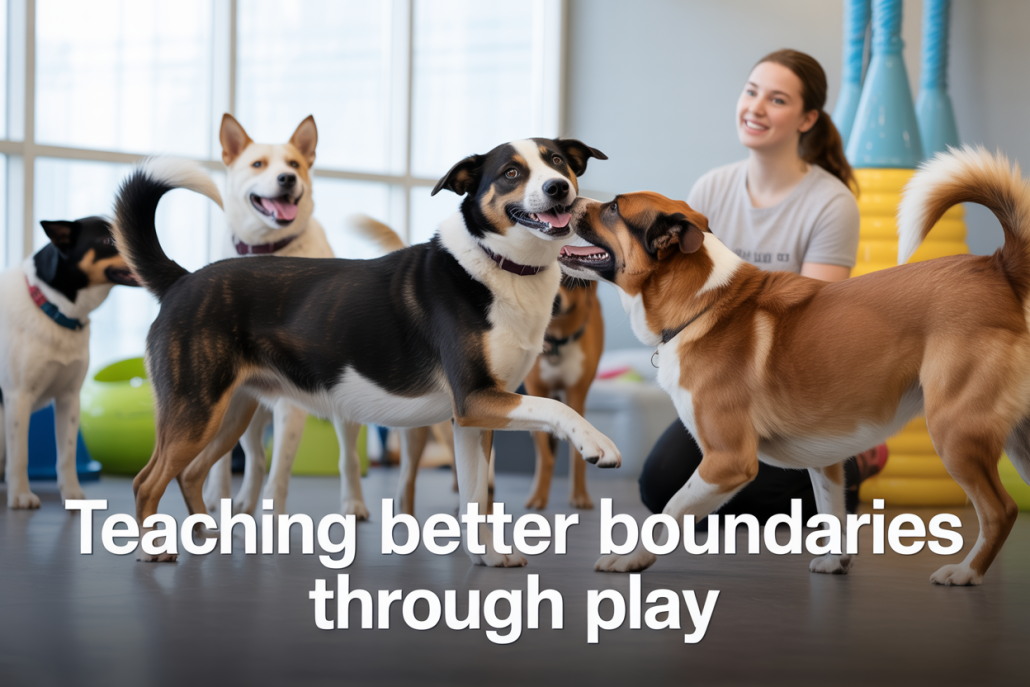
Dog Daycare Dynamics: How Group Play Teaches Better Boundaries
Dog daycare offers much more than exercise and entertainment for your furry friend. When dogs play together in supervised groups, they naturally learn essential social skills and develop better boundaries through real-time interactions with their peers. This article is for dog owners considering daycare options, current daycare clients wanting to understand the benefits, and pet professionals seeking insights into canine social development.
Group play behavior creates powerful learning opportunities that single-dog households simply can’t replicate. Dogs develop crucial social skills through pack dynamics, reading body language, and respectful play. We’ll explore how natural pack behavior in dogs creates the foundation for healthy social development, examine the science behind boundary learning through social play, and discuss key social skills dogs develop in daycare settings.
You’ll discover why dog daycare benefits extend far beyond physical exercise. The structured environment of dog play groups enables continuous canine social learning, with boundary setting occurring organically through peer feedback and professional guidance.
Understanding Natural Pack Behavior in Dog Groups
How Dogs Establish Hierarchy Through Play Interactions
Dogs naturally form social structures through daily interactions, and dog daycare provides the ideal environment for this process to unfold. When multiple dogs come together for group play, they instinctively assess each other’s confidence, energy, and social preferences. This isn’t about aggressive dominance – it’s more like a dance where each dog finds their comfortable spot in the group dynamic.
The establishment of hierarchy happens through subtle exchanges during play. One dog might consistently initiate games while another prefers to follow. Some dogs naturally take breaks to monitor the group, acting as informal peacekeepers, while others focus entirely on their current playmate. These preferences emerge through repeated interactions and help create stable, predictable relationships that reduce stress for everyone involved.
During canine social learning, dogs test boundaries through play wrestling, chase games, and resource sharing. A confident dog might approach a toy another dog is holding, while a more reserved dog waits for an invitation to join. These moments teach valuable lessons about reading social cues and respecting others’ space, without human intervention.
Reading Body Language Signals During Group Activities
Dog play groups offer countless opportunities to observe the intricate communication system dogs use. Their body language speaks volumes about their intentions, comfort levels, and emotional states. A relaxed dog approaches with loose, wiggly movements, while a tense dog might move stiffly with raised hackles.
Tail positions reveal immediate emotional states – a high, stiff tail often signals alertness or potential conflict, while a low, wagging tail usually indicates friendly intentions. Ear positions matter too. Forward-facing ears show interest and engagement, while pinned-back ears suggest anxiety or submission. Play bows, in which dogs lower their front end while keeping their rear elevated, serve as universal invitations that say, “I want to play, and this is just for fun.”
Facial expressions provide additional context. Soft, relaxed features with slightly open mouths indicate contentment, while hard stares or wrinkled foreheads can signal tension. Dogs in daycare settings quickly learn to read these signals from multiple playmates simultaneously, developing sophisticated social awareness that transfers to all their future interactions.
Recognizing Healthy Versus Problematic Dominance Displays
Pack behavior in dogs includes natural leadership tendencies, but healthy dominance differs from problematic behavior. Healthy leaders in dog groups tend to be calm and confident. They might claim the best sleeping spots or get first access to water bowls, but they do so without aggression or excessive guarding behaviors.
These natural leaders often serve as group stabilizers, intervening when younger or more excitable dogs get too rowdy. They use body blocking, gentle mouthing, or simply walking between feuding parties to restore calm. This type of leadership supports dog behavior modification by providing positive role models for less-experienced dogs.
Problematic dominance manifests as resource guarding, persistent bullying of specific dogs, or an inability to share space peacefully. Dogs displaying these behaviors might pin others excessively during play, refuse to allow others near food or water, or continue pursuing a dog who’s clearly trying to disengage. These behaviors require immediate staff intervention to prevent the development of negative associations with group play.
Dog daycare socialization works best when the group maintains a balanced dynamic. Most successful play groups include a mix of personality types – confident leaders, easy-going followers, and energetic players – creating an environment where every dog can learn appropriate boundary setting for dogs through positive social experiences.
The Science Behind Boundary Learning Through Social Play
How repetitive play scenarios reinforce behavioral limits
Dogs learn boundaries through repeated social interactions. When a puppy is consistently corrected by older dogs for play-biting too hard, their brain begins to wire connections between action and consequence. Dog daycare benefits become most apparent in these repeated interactions, where appropriate responses are naturally reinforced.
Think about how a dog learns to moderate their play intensity. The first time they jump on a smaller dog and get a warning growl, they might not fully understand. But after experiencing this correction dozens of times across different play partners, the pattern becomes clear. Their nervous system begins predicting these outcomes before they even make the unwanted movement.
The beauty of group play behavior lies in how dogs generalize these lessons. A correction from one dog teaches them to read similar body language from all dogs. Each play session adds another layer to their understanding of acceptable social boundaries. This repetitive learning creates muscle memory, enabling dogs to self-regulate without conscious thought.
Professional daycare environments maximize this natural learning process by ensuring dogs experience varied but consistent social feedback. The repetition doesn’t just teach what not to do; it actively rewires their default responses to be more socially appropriate.
The role of immediate consequences in shaping responses
Timing makes all the difference in canine boundary training. Dogs have roughly a three-second window to connect their actions to their consequences. In group play settings, feedback happens instantly – a dog pushes too hard, and their playmate immediately disengages or corrects them.
This immediate feedback system works because it taps into how dogs naturally communicate. Wild canines don’t give delayed corrections; they respond in the moment. Dog daycare socialization leverages this biological reality by creating environments where natural consequences happen without human intervention.
Consider what happens when a dog guards a toy inappropriately. Other dogs simply avoid them, creating immediate social isolation. The toy-guarding dog quickly learns that possessive behavior leads to loneliness, while sharing leads to continued play. No human explanation required – the consequence teaches the lesson directly.
The speed of these natural corrections also prevents confusion. Dogs don’t have to wonder why they’re being corrected or try to remember what they did wrong hours ago. The cause-and-effect relationship stays crystal clear, making learning efficient and lasting.
Building impulse control through structured group activities
Dog play groups naturally create situations that test impulse control. When multiple dogs get excited about the same toy or treat, each individual must learn to wait their turn or risk social rejection. These scenarios build self-regulation skills that transfer to all areas of life.
Structured activities amplify this learning process. Rotating toys every few minutes teaches dogs that good things come to those who wait. Group training sessions in which dogs must hold commands while others receive attention build focus and patience. Even simple activities, such as group water breaks, teach queue awareness and respect for others’ space.
The peer pressure element can’t be overstated. Dogs naturally mirror the behavior they see around them. When surrounded by well-behaved dogs who wait politely for their turn, even impulsive newcomers begin to model that same patience. Canine social learning happens through observation as much as direct experience.
These activities also provide safe ways for dogs to practice failure. If they break a command or jump ahead in line, the natural consequence is missing their turn – not a harsh correction. This gentle consequence system builds confidence while teaching impulse control.
Developing emotional regulation skills during playtime
Dog behavior modification happens naturally when dogs learn to manage their excitement levels during play. Overstimulated dogs quickly discover that their playmates disengage when energy gets too intense. This teaches them to self-regulate their arousal levels to maintain social connections.
Watch how experienced daycare dogs handle conflict resolution. They’ve learned to take breaks when tensions rise, to use calming signals before situations escalate, and to seek help from humans when needed. These emotional intelligence skills develop through repeated social practice in safe environments.
The variety of personalities in pack behavior in dog settings provides crucial learning opportunities. Shy dogs learn confidence by playing with gentle partners, while bold dogs learn restraint through interactions with more assertive playmates. Each personality type offers different lessons in emotional regulation.
Play interruptions teach perhaps the most valuable skill: how to transition between high- and low-energy states quickly. Dogs learn to shift from intense chase games to calm social grooming within seconds. This emotional flexibility is a cornerstone of effective boundary-setting for dogs throughout their lives.
Key Social Skills Dogs Develop in Daycare Settings
Learning when to engage and when to disengage
Dogs in daycare environments quickly master one of the most crucial social skills: reading body language and knowing when to approach or back off. This canine social learning occurs naturally through repeated interactions with individuals of different personalities and temperaments. A confident dog might learn that their enthusiastic approach doesn’t work with every peer, while a shy dog discovers they can set boundaries without being aggressive.
The beauty of group play behavior lies in its immediate feedback system. When a dog misreads social cues and gets too pushy, they receive clear signals from their playmates – a growl, a stiff body posture, or simply being ignored. These real-time corrections teach dogs to adjust their energy and approach based on their audience. Over time, dogs develop an intuitive sense of when another dog wants to play versus when they need space.
Practicing appropriate greeting behaviors with unfamiliar dogs
Meeting new dogs becomes a daily skill-building exercise in daycare settings. Unlike the controlled meet-and-greets at home, daycare exposes dogs to constantly changing social dynamics. Dogs learn that the polite sniff-and-circle greeting works better than the enthusiastic face-to-face rush that might trigger defensive reactions.
Dog daycare socialization offers numerous opportunities to practice greetings with dogs of varying sizes, breeds, and social preferences. A Great Dane learns to tone down their imposing presence when meeting a nervous Chihuahua, while smaller dogs discover they don’t need to compensate for their size with excessive barking or jumping. These repeated practice sessions build muscle memory for appropriate social protocols.
Developing tolerance for different play styles and energy levels
Not every dog plays the same way, and daycare environments celebrate this diversity. Wrestling enthusiasts learn to coexist with dogs who prefer chase games, while high-energy breeds discover that not everyone wants to engage in marathon play sessions. This exposure to different dog play groups teaches flexibility and adaptability.
Dogs naturally sort themselves into compatible playgroups, but they also learn to navigate mixed groups where different styles intersect. A gentle, mouthy player learns to moderate their technique with dogs who prefer non-contact play, while boisterous players develop awareness of when their energy overwhelms calmer companions. This dog social skills development creates well-rounded dogs who can adapt their play style to match their current playmates.
Building confidence through positive peer interactions
Shy or undersocialized dogs often build confidence through carefully managed group interactions. Success breeds success – each positive encounter builds upon the last, creating an upward spiral of social confidence. Dogs learn they can advocate for themselves without aggression and that most social interactions end positively.
Dog daycare benefits extend far beyond exercise and entertainment. Confident peer interactions teach dogs that the world is generally a friendly place filled with potential playmates rather than threats. This confidence transfers to other areas of their lives, making walks, vet visits, and new experiences less stressful.
Understanding space sharing and resource management
Daycare environments teach dogs practical lessons in sharing space and resources, which often challenge even the most well-behaved pets. Multiple water bowls, toys, and favorite resting spots create natural opportunities to practice patience and turn-taking. Dogs learn that resources aren’t always scarce and that good things come to those who wait.
Pack behavior in dogs emerges naturally as groups establish loose hierarchies around preferred spaces and activities. Rather than rigid dominance structures, dogs develop fluid social agreements about who gets first access to the sunny spot or the newest toy. This boundary-setting for dogs occurs naturally through social pressure and positive reinforcement, creating dogs who are generous with space and patient with others’ needs.
Staff Intervention Techniques That Enhance Learning
Timing Corrections for Maximum Educational Impact
The most effective corrections happen within three seconds of unwanted behavior. When dogs receive feedback during this critical window, they can clearly link the correction to their action. Professional daycare staff monitor for early warning signs such as stiff body language, prolonged staring, or resource-guarding behaviors before they escalate into conflicts.
Smart timing means interrupting negative interactions before they become rehearsed patterns. A gentle redirect when one dog starts bullying another establishes appropriate boundaries for both animals without creating fear or stress. Staff members position themselves strategically throughout play areas to catch these moments early, preventing the need for more dramatic interventions later.
The key lies in reading canine body language fluently. Experienced staff recognize when play becomes too intense by watching for signals such as pinned ears, raised hackles, or a dog stopping voluntary participation. Quick, calm interventions during these moments help dogs learn self-regulation while maintaining positive associations with group play.
Redirecting Negative Behaviors into Positive Outlets
Rather than simply stopping unwanted behaviors, skilled daycare staff channel that energy into appropriate activities. A dog exhibiting excessive mounting behavior may be redirected to a puzzle toy or encouraged to play chase games with a more compatible playmate. This approach acknowledges the dog’s need for stimulation while teaching proper social skills.
Redirection works best when staff understand what drives specific behaviors. A dog that resource guards toys might benefit from structured activities in which sharing is rewarded, while an overly rough player could be paired with confident dogs that naturally set boundaries through appropriate corrections.
Physical redirection often proves more effective than verbal commands in active play environments. Leading an overexcited dog to a different area or introducing a new activity speaks their language more effectively than repeated “no” commands, which can increase arousal.
Managing Introductions Between Incompatible Personality Types
Some personality combinations require careful orchestration to succeed. Pairing a shy, submissive dog with an overly confident one requires gradual introduction protocols that protect the timid animal while teaching the bold dog appropriate boundary-setting.
Successful introductions start with parallel activities where dogs can observe each other without direct interaction. Staff create opportunities for positive associations by offering treats or engaging in favorite activities while dogs remain at comfortable distances. The goal is to build positive associations before expecting direct interaction.
Buffer dogs—calm, well-socialized animals—often serve as bridges between incompatible personalities. These natural peacekeepers help anxious dogs gain confidence while modeling appropriate play styles for overly exuberant companions. Experienced staff identify these special dogs and strategically leverage their influence to support canine social learning.
Using Environmental Management to Support Natural Learning
Physical space design plays a crucial role in supporting healthy socialization for dogs in daycare. Multiple play areas allow staff to separate groups by size, energy level, and social skills, reducing overwhelming situations that hinder learning.
Elevated platforms, tunnels, and varied terrain create natural opportunities for dogs to practice spatial awareness and respect boundaries. When resources like toys or resting spots are strategically placed, dogs learn to navigate social situations without direct human intervention.
Environmental management includes controlling group sizes to prevent overstimulation. Smaller groups allow individual dogs to practice social skills without getting lost in chaotic situations. This approach supports natural pack behavior in dogs while ensuring each animal receives appropriate social challenges that match their current skill level.
Measuring Progress in Boundary Development
Tracking Improvements in Self-Control During High-Excitement Moments
Watching dogs learn self-control in exciting situations is like seeing tiny lightbulb moments happen throughout their daycare experience. During high-energy play sessions, well-socialized dogs gradually develop the ability to pause and check themselves before crossing boundaries. You’ll notice dogs who previously might have bulldozed through play groups now take breaks, assess the situation, and re-enter play more appropriately.
Staff members track these improvements by observing specific behaviors: dogs who previously couldn’t contain their excitement when new playmates arrived now show calmer greetings. They might approach more slowly, offer play bows instead of jumping, or even wait for permission signals from other dogs before engaging. These moments of self-regulation demonstrate significant progress in canine boundary training and showcase the real dog daycare benefits that extend far beyond simple exercise.
The most telling improvements often occur during transition periods – when toys come out, during feeding times, or when favorite playmates enter the space. Dogs who’ve developed better self-control will demonstrate patience, take turns, and respond appropriately to both canine and human social cues.
Monitoring Reduction in Resource Guarding Behaviors
Resource guarding presents one of the clearest metrics for measuring boundary development in dog play groups. Dogs naturally protect valuable items, but through structured group experiences, they learn to share space and resources more effectively. Staff document specific incidents and track frequency patterns over time.
Initial assessments may reveal dogs who hover possessively over water bowls, claim specific resting spots, or become tense around high-value items such as toys or treats. Through consistent dog daycare socialization, these behaviors typically diminish as dogs learn that resources are abundant and that sharing doesn’t mean losing out.
Progress shows up in subtle ways: a dog who previously guarded the tennis ball now drops it willingly when another dog approaches. Dogs begin self-regulating around food and water stations, naturally creating space for others without staff intervention. Some dogs even develop generous behaviors, actively moving away from resources to allow more timid playmates access.
Tracking sheets help staff identify which environments or triggers still challenge individual dogs, allowing for targeted intervention strategies. The goal isn’t to eliminate all protective instincts but to help dogs understand appropriate boundaries around shared resources.
Observing Increased Respect for Other Dogs’ Personal Space
Pack behavior in dogs involves complex spatial awareness that develops through repeated social interactions. Staff carefully monitor how dogs approach, engage with, and disengage from their playmates as clear indicators of boundary respect development.
Early socialization stages often feature dogs who struggle with spatial boundaries – they might persistently follow other dogs, invade sleeping spaces, or continue play attempts despite clear “no” signals from playmates. Successful group play behavior modification shows dogs learning to read and respect these social cues naturally.
Progress manifests in dogs who notice when playmates retreat to quiet corners and choose not to follow. They begin to recognize stress signals such as lip-licking, yawning, or body stiffening, and respond by giving space. Dogs tend to choose appropriate playmates whose energy levels and play styles match their own, rather than forcing interactions with incompatible personalities.
Staff document these improvements in daily observation logs, noting specific instances in which dogs demonstrate newfound spatial awareness. The most successful dogs develop an intuitive understanding of personal space bubbles, approaching with appropriate distance and waiting for invitation signals before closing the gap.
Documenting Enhanced Communication Skills with Both Dogs and Humans
Communication development represents perhaps the most complex aspect of boundary learning to measure, yet it provides the richest insights into canine social learning progress. Dogs develop sophisticated signaling systems through daycare experiences that extend their natural communication repertoire.
With other dogs, improved communication manifests as clearer play signals, more effective calming behaviors, and better conflict-resolution skills. Dogs learn to use their full body language vocabulary: play bows become more pronounced, displacement behaviors like sniffing or scratching effectively diffuse tension, and warning signals become more subtle yet effective.
Dog social skills development with humans often progresses even more dramatically. Dogs learn to seek help from staff when overwhelmed, approach for comfort during stressful moments, and even alert caregivers to potential conflicts between other dogs. They develop a nuanced understanding of human body language and verbal cues, responding appropriately to redirection before situations escalate.
Staff track these improvements through detailed behavior logs that capture both the frequency and sophistication of communication attempts. Dogs who initially rely on pushy or attention-seeking behaviors begin using gentler, more effective strategies to get their needs met. The most advanced dogs become emotional support resources for newer or more anxious playmates, demonstrating how dog behavior modification through social learning creates positive ripple effects throughout the entire group dynamic.
Group play at dog daycare offers something that solo walks and backyard time simply can’t match—the chance for dogs to learn from each other. Through natural pack interactions, supervised social play, and skilled staff guidance, dogs develop essential boundaries that make them better companions both in daycare and at home. The social skills they develop, from reading body language to respecting personal space, lay a foundation for confident, well-adjusted behavior.
The real magic happens when daycare staff know exactly when to step in and when to let dogs work things out naturally. This balance helps dogs build genuine confidence rather than dependence on human intervention. If you’re considering daycare for your pup, look for facilities that prioritize these learning opportunities and track your dog’s social development over time. Investing in proper group socialization yields a dog that navigates the world with better manners and stronger social skills.
Ready to take your dog’s behavior to the next level? Our Basic Dog Training in Carlsbad, CA, builds essential obedience and strengthens the bond between you and your pup. For more personalized results, our Private Dog Training in Carlsbad, CA, focuses on your dog’s individual goals and challenges. Prefer an immersive experience? Our Board & Train in Carlsbad, CA delivers consistent, hands-on instruction for faster, lasting progress. Visit our homepage to learn more about Dog Training and explore expert-led Dog Training in Carlsbad that transforms behavior through positive, proven methods.

