Reinforcing Basic Obedience Commands for Safety in Aging Dogs
Why Obedience Training Becomes More Critical as Dogs Age
Your senior dog has mastered sit, stay, and come for years. They’ve been reliable, predictable, trustworthy. Then something shifts.
The “come” command gets ignored. The “stay” wavers. Your once-obedient companion seems to operate on a different frequency entirely.
If this sounds familiar, you’re not witnessing stubbornness or defiance. You’re watching the real impact of aging on your dog’s ability to process, remember, and execute commands they’ve known their entire lives.
This is exactly why obedience reinforcement becomes non-negotiable as dogs enter their senior years. It’s not about teaching new tricks at age 10 or 12. It’s about maintaining the foundation that keeps your aging dog safe, confident, and living their best life for whatever time remains.
Refreshing basic commands isn’t punishment or re-training from scratch. It’s a proactive approach that acknowledges how your dog’s brain and body are changing, then adapts your training strategy accordingly.
How cognitive decline affects command responsiveness in senior dogs
A senior dog’s brain isn’t the same as their younger self’s brain. Cognitive dysfunction affects how signals travel between neurons, how memories are stored, and how quickly a dog can process what you’re asking. Studies show that senior dogs experience slower processing times, similar to how human cognition changes with age. Your dog might hear “sit” clearly but take longer to translate that sound into the physical action.
This isn’t laziness. It’s neurology. When you understand how the science behind, you realize that aging dogs need more repetition, clearer markers, and increased patience during training sessions. A command that once earned an instant response might now require a 2 to 3 second delay. Some senior dogs experience difficulty distinguishing between similar-sounding commands (like “down” vs. “sit”). Others simply need multiple exposures to re-cement what they learned decades ago.
The good news? Regular reinforcement of basic commands can slow cognitive decline and even improve neural pathways. Your senior dog’s brain remains plastic and capable of learning throughout their life, but the timeline changes.
Safety risks when aging dogs ignore basic commands
Here’s where this matters beyond just obedience for obedience’s sake. A senior dog who doesn’t respond reliably to “come” is a dog at risk of getting lost, running into traffic, or approaching other dogs unpredictably. A dog who forgets “stay” might wander off during bathroom breaks or bolt through open doors. A dog weak on “down” might jump on a toddler or knock over a frail family member.
These aren’t hypothetical scenarios. They’re daily risks that compound as your dog’s hearing dulls, their vision fades, and their judgment lapses. An aging dog’s physical limitations mean they recover more slowly from injuries. A fall caused by poor balance is far more serious at age 12 than at age 3. A dog hit by a car faces longer healing times and greater risk of complications.
When you reinforce basic commands throughout your senior dog’s life, you’re building a safety net. You’re ensuring that even if your dog’s cognitive function declines, the muscle memory and habit of responding to commands remains strong. This is in home dog at its most practical.
The connection between obedience reinforcement and quality of life
Obedience isn’t just about control. It’s about freedom and confidence. A senior dog who responds reliably to commands gets to experience more of life.
They can join you on walks without a tight leash. They can visit friends and family. They can safely explore new environments.
Dogs who don’t respond to basic commands often end up confined or isolated because their owners can’t manage them safely in unpredictable situations.
Regular basic obedience dog keeps your aging dog mentally stimulated and engaged. Even short, low-pressure training sessions trigger dopamine release and reinforce the bond between you and your dog. For senior dogs, this mental enrichment can be the difference between a dog who declines rapidly and one who remains alert and involved.
Behavioral changes that signal the need for refresher training
Some behavioral shifts in senior dogs are normal aging. Others signal that command reinforcement needs to restart. If your aging dog is ignoring commands that they’ve known for years, exhibiting confusion about familiar cues, or showing anxiety in situations that previously felt routine, these are signs your senior needs help.
House-soiling despite knowing “outside,” forgetting the “place” command they relied on, or losing track of “wait” at doorways all point to cognitive or physical decline that responds well to structured reinforcement. The earlier you notice these changes and adapt, the sooner you can rebuild that obedience foundation with methods designed specifically for aging canines.
Assessing Your Senior Dog’s Current Training Level
Evaluating hearing and vision loss before retraining
Before you even think about reinforcing commands with your senior dog, you need to understand what they can actually perceive. Hearing and vision loss happen gradually in aging dogs, and if you’re not aware of these changes, you’ll spend weeks frustrated thinking your dog is ignoring you when they genuinely can’t hear or see the cue.
Start by observing how your dog responds to everyday sounds. Does your pup wake up when you enter the room, or do they stay asleep even with noise? Can they locate where you’re calling from, or do they seem confused about your location?
Senior dogs with hearing loss often tilt their head or look directly at your face, relying on lip reading and body language instead of vocal commands. This is actually useful information for training (more on that later).
For vision assessment, watch how they navigate your home. Do they bump into furniture or hesitate before jumping down from the couch? Can they find treats you drop on a patterned floor?
Aging dogs develop cataracts, reduced light sensitivity, and peripheral vision loss. They might respond to a hand signal they’ve known for years but miss it completely if their sight has deteriorated significantly.
Be honest about these limitations. They’re not deficiencies in your dog’s intelligence or willingness to obey, they’re just part of aging. Understanding what senses are fading helps you adjust your approach during training sessions and ensures the commands you reinforce are actually received by your dog.
Identifying which commands your aging dog still knows reliably
Your senior dog has probably spent years learning basic commands, but muscle memory and cognitive processing aren’t the same in a 10-year-old dog as they were at 2 years old. You need to identify which commands stick around reliably and which ones have gotten fuzzy.
Run through your dog’s known repertoire in a low-pressure environment, ideally without distractions. Start with the essentials: sit, down, stay, come, and leave it. Test each one and note whether your dog responds quickly, hesitates, or seems genuinely confused.
Consistency matters here. A command that works reliably 80% of the time is worth reinforcing. One your dog only remembers 30% of the time might need a complete refresher approach.
Watch for partial compliance too. Your dog might sit but then immediately stand, or come when called but stop halfway. These aren’t complete failures, they’re just signs that the command needs reinforcement work. Understanding which commands are solid helps you prioritize which ones to focus on first during your training plan.
If your dog has attended dog day care or worked with professional trainers at facilities like those in San Marcos, Solana Beach, or Vista, CA, they may have stronger command retention than dogs trained purely at home. Document everything. This baseline becomes invaluable for measuring whether your efforts are actually working.
Understanding physical limitations that affect command execution
Here’s where many people miss the bigger picture. Your aging dog might know the sit command perfectly, but arthritis or hip dysplasia could make sitting painful. A dog with spinal issues might understand down but physically struggle to assume that position. This isn’t about obedience, it’s about pain and physical capability.
Observe how your dog moves naturally. Do they favor one hind leg? Does their back seem to round or stiffen when they try to lie down? Can they jump or climb stairs without hesitation? Senior dogs often have limited range of motion, reduced muscle mass, and joint problems that make certain commands genuinely difficult.
During your assessment, use canine body language to identify whether your dog is struggling physically or simply not cooperating. Tight posture, slow movements, or reluctance to complete a command all signal that physical limitations matter. This information shapes how you’ll eventually reinforce these commands using techniques suited to their age.
Document any limping, stiffness, or difficulty transitioning between positions. These observations inform discussions with your vet and guide how you’ll adapt your training approach moving forward.
Creating a baseline for measuring progress in senior dog training
You can’t know if your training is working unless you establish a measurable starting point. Create a simple chart tracking each command your dog knows. Record the date, the command, your dog’s response (success, partial, failure), and any environmental factors (tired, distracted, in pain).
Spend one week just gathering data without attempting any reinforcement training. Test each command once per day in consistent conditions, ideally at the same time and location. Track approximately 7-10 repetitions per command. This gives you realistic numbers about your senior dog’s current reliability.
Your baseline might look like: Sit = 8 out of 10 successes, Down = 5 out of 10, Come = 6 out of 10, Stay = 4 out of 10. These numbers become your reference point for measuring progress. After implementing targeted reinforcement techniques suited to aging dogs, you’ll know whether your efforts are moving the needle.
This methodical approach prevents you from chasing your tail with training that isn’t actually improving your dog’s obedience. It also helps you prioritize. Focus first on commands your dog almost knows, then work toward the ones that have deteriorated significantly.
Adapting Training Techniques for Aging Dogs
Modifying reward systems for senior palates and energy levels
Your senior dog’s taste preferences and digestive system have changed considerably since their younger days. What motivated them at age three won’t necessarily work at age twelve. Treats that once sent them bouncing off the walls might now cause upset stomachs or simply fail to capture their attention.
The key is finding high-value rewards that match both their current palate and physical capability. Soft, easily digestible treats work far better than hard kibble that requires aggressive chewing. Consider warming up treats slightly to enhance their aroma, which helps when your dog’s sense of smell has diminished. Smaller portions are essential too, since older dogs tire more quickly and their appetites often decrease.
Beyond food-based rewards, don’t overlook the power of non-edible incentives. Gentle praise, a favorite toy, or even just a brief pause in training combined with physical affection can be incredibly motivating for senior dogs. Some older pups respond better to scent training opportunities or the chance to explore a familiar, safe space than they do to traditional treats. Think about what genuinely excites your particular dog at this life stage, then build your reward strategy around those preferences.
Energy management during training also matters more than ever. Avoid training right after meals or when your dog is already fatigued. Mid-morning sessions, when most senior dogs feel their best, yield better results. Keep rewards modest in size and frequency, allowing your dog to stay focused without becoming overstimulated or exhausted.
Using shorter, more frequent training sessions to prevent fatigue
This might be the single most important adjustment you make in your approach. Forget the traditional thirty-minute training block. Senior dogs need something completely different: multiple five to ten-minute sessions spread throughout the day.
Why? Aging dogs have limited physical and mental stamina. Even if they’re willing to keep going, their bodies and brains are working harder than they used to. A six-minute session followed by a rest period is far more effective than pushing for twenty minutes straight. You’ll actually see better retention and fewer behavioral setbacks with this approach.
Spacing sessions throughout the day also taps into natural learning patterns. Morning sessions work well for introducing new concepts or reinforcing critical safety commands. Afternoon sessions can focus on refreshing previously learned behaviors. Evening sessions, kept especially brief, help wind down while maintaining engagement. If your dog attends transitioning dogs, coordinate with your facility about timing to avoid double-training stress.
Watch for signs of fatigue: slowed response time, wandering attention, or physical signs like stiffness or heavy breathing. The moment you notice these, wrap up the session. Ending on a positive note, even if you’ve only practiced one command successfully, builds confidence and keeps your senior dog eager for the next session.
Incorporating hand signals when hearing becomes a challenge
Many senior dogs experience some degree of hearing loss. It might be gradual, or you might wake up one morning realizing your dog didn’t respond to the doorbell. This doesn’t mean training stops; it means you adapt by introducing or emphasizing hand signals alongside verbal commands.
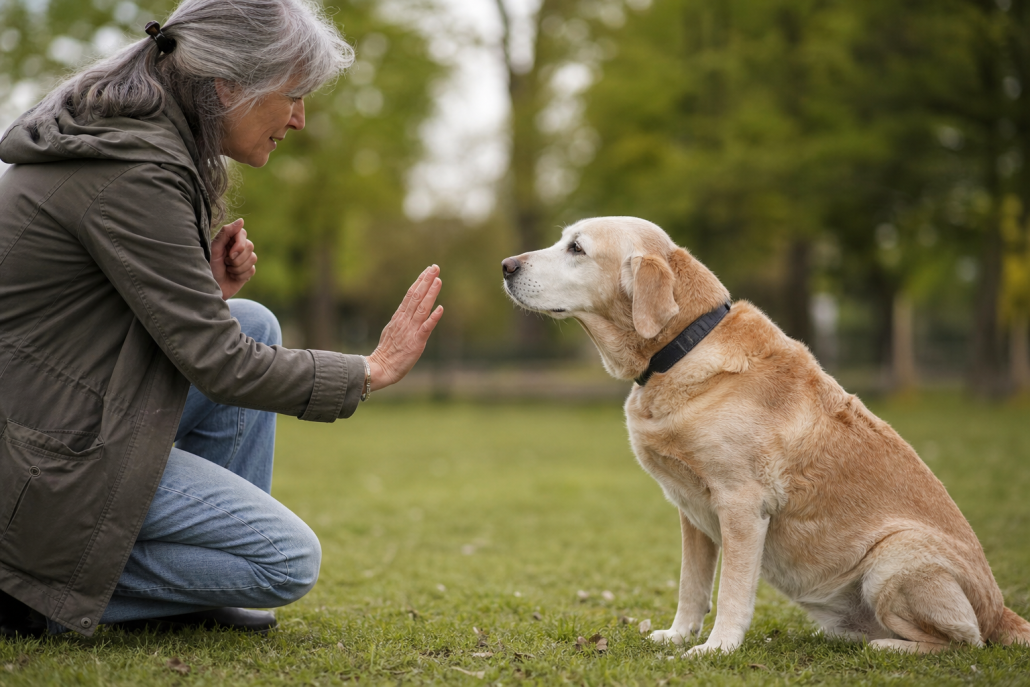
Start pairing clear, consistent hand signals with every verbal command right now, even if your dog hears perfectly. This builds a foundation that makes the transition seamless if hearing declines. A raised hand for “sit,” a sweeping motion for “come,” or pointing for “go to your place” become as powerful as any word you speak.
Hand signals must be distinct and exaggerated enough for older eyes to detect, especially if vision has also declined. Avoid small, subtle movements. Keep your dog relatively close during training so they can see you clearly. Natural lighting helps significantly, so train near a window when possible rather than in dim corners of your home.
Visual cues also become part of your broader communication strategy. Eye contact, body positioning, and facial expressions all contribute to understanding. Dogs are remarkably good at reading our physical language when we make it clear and consistent.
Adjusting pace and repetition to match older dogs’ learning speed
Senior dogs learn differently. Their brains are processing information at a different rate than younger dogs, and that’s not a weakness; it’s just reality. Slower introduction of concepts and increased repetition are necessary, not optional.
Break commands into smaller steps. Instead of expecting a complete “sit-stay,” practice “sit” alone for several sessions before adding duration. This prevents confusion and sets your dog up for success. When implementing age-appropriate training techniques, patience becomes your most valuable tool.
Repetition should be consistent but not monotonous. Practice the same command multiple times daily across different sessions, but vary the location, time, and context slightly. This prevents boredom while reinforcing the behavior from different angles.
Accept that progress looks different now. Your senior dog might take three times longer to learn a new behavior than they would have at age four. That’s completely normal. Celebrating small wins and maintaining realistic expectations keeps both you and your dog motivated and positive throughout the process.
Reinforcing Essential Commands for Safety and Care
Strengthening ‘sit’ and ‘stay’ for medical appointments and grooming
As your senior dog ages, veterinary visits and grooming appointments become increasingly frequent. These moments demand rock-solid obedience because your dog needs to remain calm and still while handlers examine sensitive areas, draw blood, or trim nails. A senior who can reliably sit and stay reduces stress for everyone involved, including the professionals working with your pup.
Start by refreshing the sit command in low-distraction environments. Use high-value rewards like small pieces of chicken or cheese. Your older dog may need longer to process the cue, so pause two to three seconds between your command and the treat. Patience here is everything. Once sit is solid indoors, practice it during brief car rides to the vet’s parking lot, then in the waiting room itself.
The stay command requires incremental distance building. Stand three feet away and ask your dog to sit and stay for 10 seconds. Reward heavily.
Over weeks, gradually increase duration to 30 seconds, then move further away. At the vet’s office, your goal isn’t a marathon stay, just 5 to 10 minutes of calm settling on a mat or bed. This manageable expectation respects your senior’s physical limitations while keeping them safe during handling.
Teaching reliable ‘come’ commands to prevent wandering and getting lost
A senior dog with cognitive decline or hearing loss may wander away from home, increasing the risk of getting lost. Even brief trips outside require a rock-solid recall. Teaching or reinforcing a reliable come command is one of the most practical safety skills you can invest time in right now.
Practice recall in your backyard first, using a long training line (10 to 15 feet) clipped to your dog’s collar. Call your dog’s name once, then use an upbeat tone saying “come.” Reward immediately with treats and praise when they reach you. Keep sessions under five minutes, repeating this three to four times per week. The key is consistency without frustration.
Indoors, reinforce come throughout the day using real-life scenarios. When your senior approaches their food bowl, say “come” and reward before they get there. When they gravitate toward a comfortable spot, call them over and offer a treat. This passive practice embeds the command into daily life. If cognitive changes are affecting responsiveness, use higher-value rewards like special treats reserved only for recall practice. Your dog’s safety depends on this command working reliably when it matters most.
Practicing ‘leave it’ to protect against harmful foods and toxins
Senior dogs may lose their discriminatory eating habits. A dog who ignored table scraps for years might suddenly scavenge anything within reach. The leave it command becomes a critical safety barrier against spoiled food, chocolate, medications, and seasonal toxins like xylitol found in sugar-free products.
Teach or refresh leave it using a two-treat system. Show your older dog a low-value treat (like a piece of kibble) in your closed fist. When they lose interest or pull back, immediately open your hand and reward with a higher-value treat from your other hand. Practice this five to ten times daily for short two-minute sessions. Consistency matters more than duration.
Once your dog understands the concept indoors, practice in real-world scenarios. Drop a treat on the floor during walks and say “leave it,” then immediately reward when they ignore it. Graduate to practicing around seasonal hazards like fallen fruit or garden debris. Understanding physical limitations helps you avoid situations where your senior can’t physically turn away quickly. Position yourself to intervene if needed, especially outdoors where hazards multiply.
Maintaining ‘down’ for controlled rest during pain or discomfort
The down command serves practical purposes beyond obedience. It signals your senior to settle into a restful position, ideal when they’re experiencing joint pain or mobility issues. A dog who responds to down will lie down on cue at home, at the vet’s office, or during grooming, rather than fighting pain by standing or pacing.
Teach down by luring your sitting dog’s nose toward the ground using a treat. As their elbows touch the floor, mark the behavior with “yes” and reward. Don’t use the word “down” as a correction. Keep it positive and gentle. Practice three to four times weekly in sessions lasting only two or three minutes, respecting your dog’s comfort level.
Position yourself close enough to help your senior settle without strain. If arthritis makes lowering painful, reward the attempt rather than a perfect position. The goal is building a pattern where your dog associates down with comfort and relief, not forced submission. With optimizing senior dog, you create manageable expectations that honor aging bodies while maintaining the obedience foundation your senior dog relies on for safety and quality of life.
Managing Training in Day Care and Professional Settings
Communicating aging dog training goals to day care staff
When your senior dog spends time at a professional facility, clarity between you and the staff becomes non-negotiable. Day care environments can be chaotic, with multiple dogs interacting simultaneously, which means handlers need crystal-clear instructions about your older dog’s specific needs and training objectives.
Start by providing written documentation of your aging dog’s current obedience level and any physical or cognitive limitations they’re experiencing. Include details like “responds to ‘sit’ 80% of the time but needs extra time to process commands” or “struggles with stairs due to joint pain.” This isn’t just helpful information; it’s essential context that prevents staff from pushing your dog beyond safe boundaries.
Have a face-to-face conversation with the lead trainer or day care manager before enrollment. Discuss which commands are non-negotiable for safety (like “leave it” or recall commands) and which ones you’re actively reinforcing at home. Ask what their experience is with senior dogs and whether they’ve adapted their methods for older canines. Facilities that specialize in working with mature dogs understand the pace and patience required.
Request regular updates. Weekly check-ins or progress notes help you track whether the training reinforcement happening during day care aligns with your home efforts. Photos or short videos showing how your dog responds to specific commands provide concrete feedback about progress.
Consistency between home training and facility reinforcement
Inconsistency is the enemy of training, especially with aging dogs whose cognitive capacity for learning has shifted. If you’re reinforcing “down” with high-value treats at home but the day care facility uses a different reward system or timing, your senior dog gets confused about what’s actually expected.
Before enrolling in any program, ask the facility to match your reward structure. If your dog responds best to specific treats or toys, bring those from home. Request that staff use the same verbal cues and hand signals you use. This sounds simple, but many facilities have standardized methods that don’t align with what a particular dog has learned.
Create a one-page reference sheet listing each command your dog knows, the exact cue you use (verbal and visual), and the reward they prefer. Leave this with the handler. Some facilities won’t adapt their methods, and that’s important information for deciding whether that environment suits your aging dog’s needs.
The goal during day care isn’t to introduce new commands. It’s to maintain the skills your dog already has while providing safe socialization and mental enrichment. When dog training focuses on reinforcement rather than advancement, consistency becomes easier to achieve.
How professional trainers can work with physical and cognitive limitations
A trainer worth their credentials understands that aging dogs need modified approaches. They should recognize signs of fatigue, joint discomfort, or cognitive confusion and adjust their methods immediately rather than pushing forward.
Effective trainers working with senior dogs structure sessions around shorter durations with frequent breaks. Instead of one 30-minute session, they might do three 10-minute sessions throughout the day. This prevents exhaustion and keeps your dog engaged without physical strain.
They also understand that sensory changes matter. If your dog has hearing loss, relying solely on verbal commands won’t work; hand signals become critical. If vision is declining, training environments should have consistent layouts to prevent confusion and anxiety. Cognitive changes require patience with slower processing times and recognition that some dogs simply won’t retain new information at their previous speed.
Quality trainers working with older canines emphasize low-impact exercises and body awareness. Teaching a senior dog to navigate obstacles carefully or move slowly through transitions protects aging joints. They prioritize commands that enhance safety and independence over flashy tricks.
Monitoring progress and adjusting training plans as abilities change
Your senior dog’s physical and cognitive abilities can shift surprisingly fast. A training plan that worked three months ago might need adjustment as arthritis progresses or cognitive decline accelerates. Regular assessment prevents frustration on both sides.
Schedule monthly check-ins with whoever is handling training at your chosen facility, whether that’s day care staff or a professional trainer offering programs like boot camp. Discuss what’s working, what’s become more difficult, and what needs to change. This isn’t failure; it’s responsible adaptation.
Watch for warning signs that your dog is struggling. Increased anxiety about attending day care, reluctance to perform commands, or physical signs of pain (limping, stiffness after sessions) all indicate the current approach needs modification. Sometimes that means shorter sessions, different times of day, or smaller group sizes.
Keep detailed notes about your dog’s responses at home and at the facility. Over time, patterns emerge that inform smarter decisions about which training methods continue and which need retiring. Your aging dog’s safety and confidence always come before checking boxes on a training checklist.
Troubleshooting Common Challenges in Senior Dog Training
Addressing confusion between new behaviors and cognitive decline
One of the trickiest parts of senior dog training is distinguishing between what’s actually cognitive decline and what’s simply a dog forgetting a command they haven’t practiced in weeks. This matters because your response will be completely different depending on which one you’re dealing with.
When a senior dog suddenly seems confused about a command they’ve known for years, pause and ask yourself: Have we been actively reinforcing this command recently? Or has it been sitting dormant? A dog with mild cognitive dysfunction might show disorientation, pacing, or appearing lost in familiar spaces.
But a dog who simply hasn’t done the “sit” command in three months? That’s just rustiness, not decline. The fix is straightforward: return to shorter, more frequent practice sessions with high-value rewards to reactivate that neural pathway.
True cognitive decline typically comes with other signs like disrupted sleep-wake cycles, increased anxiety, or loss of house training reliability. If your aging dog is struggling with obedience but their sleep and bathroom habits are normal, you’re probably looking at a training gap rather than a health issue. That said, always rule out underlying pain or medical conditions with your veterinarian before attributing command confusion to either cause.
Handling resistance to training due to arthritis or pain
A senior dog resisting a command they once knew willingly might not be stubborn or forgetful. They might be in pain. Arthritis, hip dysplasia, and spinal issues become increasingly common in older dogs, and asking them to sit, lie down, or hold a stay can genuinely hurt.
Watch your dog’s body language closely. Do they hesitate before responding? Whimper slightly when lowering into a down position?
Show stiffness after training sessions? These are red flags that pain is the real issue. If you suspect discomfort, modify the command itself rather than pushing through.
Instead of a full “down,” accept a bow or a gentle crouch. Replace long stays with brief ones. Keep sessions short and on softer surfaces like grass or carpet instead of hard flooring.
Pain management matters enormously here. Work with your vet about supplements, medications, or physical therapy options that might make movement less painful, so your dog can actually comply without suffering. Training becomes genuinely cruel if you’re rewarding compliance that causes physical damage. The goal isn’t to force obedience at any cost; it’s to maintain safety and communication with a dog whose body is aging.
Rebuilding confidence in dogs who’ve lost command reliability
Some senior dogs have experienced a confidence crisis. Maybe they were once stellar at obedience, but repeated failures (due to confusion, pain, or hearing loss they weren’t compensating for) eroded their willingness to try. These dogs hesitate before responding, seem anxious about training, or simply disengage entirely.
Rebuilding that confidence requires starting so simple that success is virtually guaranteed. Go back to basics with commands your dog clearly still knows and performs eagerly. Shower them with genuine enthusiasm and high-value rewards for every small win.
Make training sessions feel like play, not work. Keep them incredibly short (60 to 90 seconds) so your dog ends on a positive note and wants to come back tomorrow.
If you’ve enrolled your senior in a professional setting, communication with your trainer becomes critical. A trainer experienced in advanced dog training or similar specialized programs understands that rebuilding confidence sometimes means temporarily ignoring new behaviors and focusing entirely on rekindling joy in training itself.
When to pause training and focus on comfort instead
Here’s something most training guides won’t tell you: sometimes the most responsible choice is stopping obedience work altogether and pivoting to comfort and quality of life.
If your senior dog is in significant pain, showing signs of advanced cognitive decline, or simply appears stressed by training sessions, stepping back isn’t failure. It’s compassion. In the final stages of a dog’s life, enforcing obedience commands they may not understand or physically manage is counterproductive and unkind.
That doesn’t mean abandoning safety entirely. You can maintain essential commands like “come” or “stop” using gentle, pressure-free methods, but aggressive or goal-oriented training feels wrong at this stage. Instead, focus on comfort, pain management, and creating positive interactions that don’t demand performance.
The beauty of having invested years in proper obedience training is that those foundation behaviors remain deeply embedded, even in a declining senior dog. You’re not losing everything by pausing formal training. Rather, you’re shifting your priority from teaching new skills to ensuring your aging companion’s final chapters are filled with comfort, dignity, and unconditional support. That shift is exactly what your senior dog deserves.