
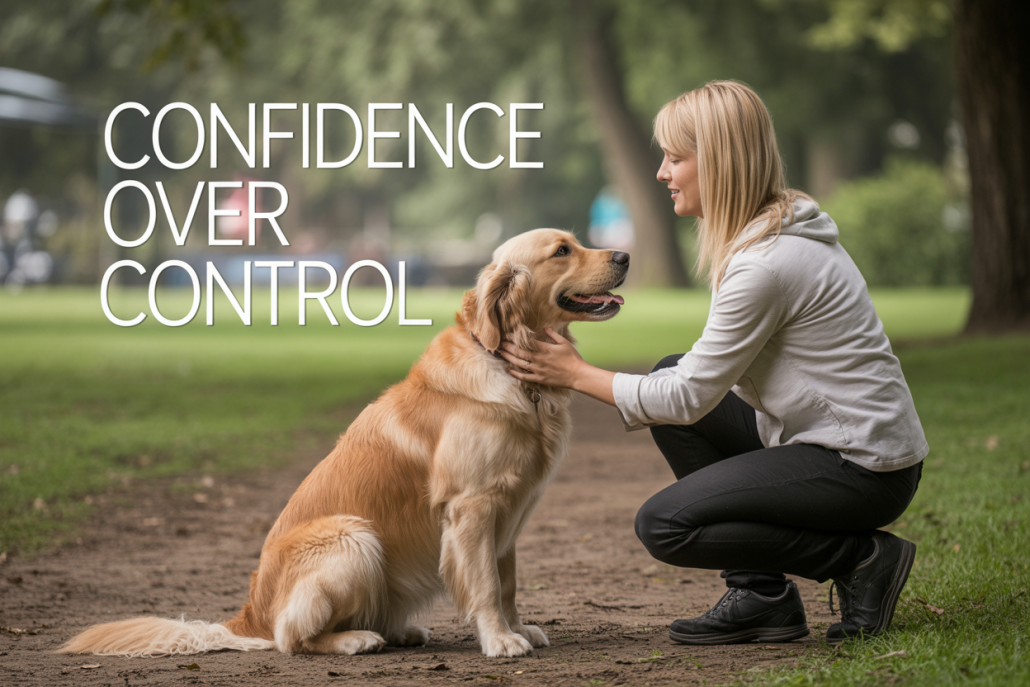
Confidence Over Control: Rethinking Dog Obedience for Real-World Success
Traditional dog training often focuses on getting your dog to follow commands perfectly, but this approach can leave you and your pup struggling when real life gets messy. Dog confidence training offers a better path forward—one that builds trust, independence, and genuine partnership between you and your dog.
This guide is for dog owners who want their pets to thrive in everyday situations, not just perform in controlled environments. You’ll learn why confidence-based dog training creates more resilient, adaptable dogs than rigid obedience methods ever could.
We’ll explore why traditional training methods often fail in the face of distractions and unexpected situations. You’ll discover practical techniques for building canine confidence that help your dog make smart choices on their own. Most importantly, you’ll learn how to shift from demanding control to using cooperative dog-training methods that strengthen your bond and prepare your dog for real-world success.
Get ready to rethink everything you thought you knew about dog training. Your dog’s confidence—not their compliance—holds the key to a truly successful partnership.
Why Traditional Dog Training Methods Fall Short in Real Life
The limitations of dominance-based approaches
Traditional dog training has long relied on dominance and alpha theories, but this approach creates more problems than it solves. The idea that dogs need a “pack leader” who controls their every move stems from outdated research on captive wolves that doesn’t apply to domestic dogs living in human households.
When trainers rely on force, intimidation, or punishment to establish dominance, they often trigger fear responses rather than genuine cooperation. Dogs trained this way may appear obedient in controlled environments, but they’re actually suppressing natural behaviors out of anxiety rather than developing true understanding and partnership with their handlers.
Dog confidence training offers a stark contrast to these methods. Instead of breaking down a dog’s spirit through dominance, confidence-based approaches build trust and communication. Dogs trained with positive reinforcement and respect for their emotional state develop genuine enthusiasm for learning and cooperating with humans.
The dominance model also fails because it treats all dogs as identical pack animals, even though each dog has unique personality traits, learning styles, and emotional needs. A sensitive Border Collie requires completely different handling than a bold Terrier, yet dominance-based methods apply the same harsh techniques across the board.
How rigid obedience creates anxious and reactive dogs
Strict obedience training that demands immediate compliance without considering the dog’s emotional state often backfires spectacularly. When dogs are forced to perform commands regardless of their comfort level or understanding, they develop learned helplessness and chronic stress.
Positive dog training techniques recognize that true cooperation comes from a dog who feels safe and confident in their environment. Rigid training methods that punish mistakes or natural dog behaviors create dogs who are constantly walking on eggshells, never knowing when they might face correction.
These anxious dogs often become reactive because they’ve learned that the world is unpredictable and potentially threatening. A dog who’s been yanked on a leash every time they showed interest in another dog may eventually become reactive toward all dogs, not out of aggression but from fear and frustration.
The irony is that owners seeking perfect obedience often end up with dogs who shut down emotionally or explode with pent-up stress. Confidence-based dog training prevents these issues by teaching dogs to think through situations and make good choices rather than simply suppressing their instincts through fear.
The gap between training class success and real-world failures
Many dog owners experience frustration when their perfectly behaved classroom star becomes a completely different animal in real-world situations. This disconnect happens because traditional training focuses on mechanical responses in sterile environments rather than building genuine understanding and adaptability.
In training classes, distractions are minimal, and scenarios are predictable. Dogs learn to sit, stay, and heel in a controlled gym setting, but they haven’t developed the confidence and decision-making skills needed for busy sidewalks, crowded parks, or unexpected encounters with children, bikes, and other dogs.
Real-world dog training requires a different approach entirely. Dogs need to learn how to process new information, remain calm under pressure, and look to their handlers for guidance rather than simply executing memorized commands. Traditional methods often produce robots that fail when faced with situations not specifically practiced.
Dog obedience alternatives focus on building a dog’s ability to think through challenges and maintain emotional balance in unpredictable environments. This creates dogs who are truly reliable partners rather than merely well-drilled performers who function only under perfect conditions.
The most successful dogs are those who’ve been taught to be confident problem-solvers rather than anxious rule-followers. They approach new situations with curiosity rather than fear because they trust their handlers and believe in their own ability to navigate the world successfully.
Understanding Confidence-Based Training Principles
Building Your Dog’s Self-Assurance Through Positive Experiences
Dog confidence training starts with creating a foundation of positive experiences that help your dog navigate the world with assurance. Instead of constantly correcting what your dog does wrong, focus on setting them up for success in manageable situations. Start with environments where your dog feels comfortable, then gradually introduce new challenges while maintaining a supportive atmosphere.
Think about a dog who’s nervous around strangers. Rather than forcing interactions, you’d begin by having your dog observe people from a comfortable distance where they feel safe. As they relax, you might reward calm behavior with treats or praise. Over time, you can decrease the distance as your dog’s confidence grows. This approach builds positive associations instead of creating fear-based compliance.
Building canine confidence also means allowing your dog to explore and make choices within safe boundaries. When dogs have opportunities to investigate their environment and make decisions, they develop problem-solving skills and self-reliance. This might mean letting them choose which path to take on a walk or allowing them to figure out how to navigate around an obstacle rather than immediately guiding them.
Teaching Decision-Making Skills Instead of Blind Compliance
Cooperative dog training methods prioritize teaching dogs how to think rather than simply react to commands. Traditional obedience often creates robots that follow instructions without understanding the reasoning behind them. When these dogs encounter unfamiliar situations, they lack the decision-making skills to respond appropriately.
Consider teaching your dog to “wait” at doorways. Instead of demanding immediate compliance, you can teach them to assess the situation and choose to pause. Start by waiting at the door yourself to demonstrate the behavior. When your dog naturally pauses, reward them. This teaches them that checking with you before proceeding leads to good outcomes.
Confidence-based dog training encourages dogs to evaluate situations and make appropriate choices. For example, when teaching recall, instead of repeatedly drilling the command, you can create scenarios in which coming to you is the most appealing option. Hide behind trees during walks and call your dog excitedly when they look for you. This makes returning to you feel like a fun game rather than an obligation.
Dogs who learn to think through problems become more adaptable and confident in new situations. They develop the ability to generalize their learning across different contexts, making them more reliable partners in real-world scenarios.
Creating Emotional Stability for Long-Term Behavioral Success
Emotional stability forms the cornerstone of lasting behavioral change. Dogs who feel secure and confident are naturally more responsive to guidance and less likely to develop problematic behaviors rooted in anxiety or stress. Positive dog training techniques focus on creating emotional balance rather than just suppressing unwanted behaviors.
Stress and fear impede learning, making it nearly impossible for dogs to retain information or make sound decisions. When dogs feel safe and supported, their brains remain open to new experiences and learning opportunities. This is why punishment-based methods often fail in the long term – they may stop a behavior temporarily, but they don’t address the underlying emotional state that drives the behavior.
Create predictable routines that help your dog feel secure while introducing variety to build adaptability. Regular meal times, consistent sleep schedules, and familiar exercise routines provide emotional anchors. Within this framework, you can introduce new experiences gradually, always ensuring your dog has a way to communicate if they feel overwhelmed.
Dog behavior modification becomes much more effective when we address the emotional component first. A dog that barks at visitors may be reacting out of fear rather than aggression. Teaching them that visitors bring good things while respecting their need for space creates lasting change that punishment-based corrections cannot achieve.
Developing Trust-Based Communication with Your Dog
Trust forms the foundation of any successful partnership, and dog partnership training requires clear, honest communication between species. Dogs are incredibly skilled at reading human body language and emotional states, but they need consistent signals to understand what we’re asking of them.
Develop a communication system that goes beyond verbal commands. Your body language, timing of rewards, and emotional energy all send messages to your dog. When you’re calm and confident, your dog feels more secure. When you’re anxious or frustrated, they pick up on that energy and may become worried or shut down.
Real-world dog training requires building a relationship where your dog chooses to work with you rather than being forced into compliance. This also means honoring your dog’s communication. When they signal stress, discomfort, or confusion, acknowledge those signals and adjust your approach. This creates a two-way conversation that builds trust over time.
Practice reading your dog’s body language and responding appropriately. A dog who’s lip-licking, yawning, or looking away might be feeling stressed and need a break. A dog with soft eyes and a relaxed body posture is ready to engage and learn. By responding to these subtle communications, you show your dog that their feelings matter, which strengthens your bond and improves their willingness to cooperate.
Confidence over control dog training transforms the human-dog relationship from one of dominance to one of mutual respect and understanding. This approach creates dogs who are not only well-behaved but also happy, confident, and eager to engage with the world around them.
Practical Techniques for Building Canine Confidence
Environmental exposure strategies that reduce fear and anxiety
The key to building canine confidence lies in gradual, positive exposure to the world around them. Start with your dog’s comfort zone and slowly expand their boundaries. Dog confidence training works best when you create controlled situations that allow your dog to explore new environments at their own pace.
Begin with low-stimulation environments, such as quiet parks during off-peak hours. Allow your dog to investigate new smells, sounds, and surfaces without rushing them. When they show curiosity instead of fear, reward that brave behavior with treats or praise. This positive association helps build their confidence bank account.
Distance is your best tool for managing overwhelming situations. If your dog shows stress signals around busy streets or crowded areas, increase the distance until they can observe calmly. Gradually reduce the distance over multiple training sessions as their comfort increases. Never force a scared dog into situations they’re not ready for – this can create lasting negative associations.
Weather conditions offer excellent confidence-building opportunities. Rain puddles, snow, wind, and varied ground textures all offer opportunities for your dog to problem-solve and adapt. Start with brief exposures and watch for signs they’re enjoying the challenge rather than feeling overwhelmed.
Problem-solving games that enhance mental resilience
Mental challenges build confidence more effectively than physical exercise alone. Building canine confidence through problem-solving creates dogs who approach new situations with curiosity rather than fear. These activities teach your dog to figure things out independently, reducing their reliance on you for constant guidance.
Hide treats around your home or yard and encourage your dog to find them. Start easy and gradually increase difficulty. This simple game teaches persistence and builds their natural hunting instincts. Food puzzle toys work similarly, requiring your dog to manipulate objects to access rewards.
Create obstacle courses using household items like boxes, pillows, or pool noodles. Don’t focus on perfect execution – celebrate any attempt to engage with the challenges. When your dog learns to step over a broom handle or walk through a cardboard tunnel, they’re building problem-solving confidence that transfers to real-world situations.
Scent work games tap into your dog’s strongest sense while building mental resilience. Hide familiar scents in different locations and reward your dog for finding them. This positive dog-training technique gives your dog a job while building their confidence in their abilities.
Social interaction training for better public behavior
Cooperative dog training methods shine when addressing social situations. Instead of demanding perfect heel position or forcing interactions, focus on teaching your dog to make good choices around other dogs and people. This approach creates genuinely confident dogs rather than simply compliant ones.
Practice the “look and dismiss” technique when encountering other dogs. Reward your dog for noticing another dog from a distance, then immediately redirecting their attention back to you. This builds confidence in social situations while preventing reactive behaviors from developing.
Teach your dog to seek permission before greeting people. Have them sit and look at you before approaching strangers who want to pet them. This gives your dog agency in social interactions and prevents overwhelming greetings that can shake their confidence. When they choose to interact after checking with you, they’re making confident decisions rather than being forced into situations.
Group training classes provide controlled social opportunities. Look for classes that emphasize confidence-based dog training over strict obedience. The best classes allow dogs to observe others from a comfortable distance and gradually increase interaction as each dog demonstrates readiness. Your dog learns that other dogs and people aren’t threats while building social confidence in a structured environment.
Replacing Control with Cooperative Partnership
Teaching Choice-Based Behaviors for Willing Participation
When your dog chooses to perform behaviors rather than being forced into them, you create a foundation for genuine cooperation. Choice-based behaviors start with simple scenarios where your dog can succeed easily. For example, instead of commanding “sit” and physically pushing their rear down, wait for natural sitting moments and reward them immediately. This approach teaches dogs that good things happen when they make smart decisions.
The power of choice becomes evident when dogs face distractions. A dog who has learned to “choose” recall will come running even when squirrels are present, because they’ve experienced the joy of making that decision repeatedly. Start with low-distraction environments and gradually increase challenges as your dog’s confidence grows.
Present options throughout daily routines. Hold two toys and let your dog pick which one to play with. Offer different walking routes and occasionally follow their lead. These small choices build decision-making skills that transfer to more complex situations. When dogs feel they have agency in their lives, they become more engaged partners rather than reluctant followers.
Using Management Strategies Instead of Constant Corrections
Smart dog partnership training relies heavily on setting up your environment for success rather than constantly telling your dog “no.” Management strategies prevent problems before they occur, reducing stress for both you and your dog. Baby gates, puzzle feeders, and designated spaces create boundaries without confrontation.
Consider counter-surfing behavior. Instead of repeatedly correcting your dog for jumping on counters, clear the surfaces and provide appropriate outlets for their curiosity through sniffing games or puzzle toys. This confidence-based dog training approach teaches dogs to channel their natural behaviors rather than suppressing them entirely.
Management also includes timing. Feed your dog before family meals to reduce begging. Provide mental stimulation before guests arrive to help them settle more easily. These proactive strategies build successful patterns while avoiding the frustration that comes with constant corrections.
The goal is to create an environment where good choices are easier than poor ones. This doesn’t mean avoiding all challenges; rather, introduce them gradually when your dog has the skills to handle them successfully.
Developing Natural Boundaries Through Consistent Leadership
True leadership in cooperative dog training methods doesn’t come from dominance or control—it comes from being a reliable guide who helps dogs navigate their world safely. Dogs naturally look for leaders who provide clear information and consistent responses to situations.
Establish boundaries by being predictable in your responses. If you don’t want your dog on furniture, this rule applies at all times, not just when you’re in a good mood. Consistency helps dogs understand expectations without confusion or anxiety.
Leadership means advocating for your dog in social situations. If another dog is making yours uncomfortable, step in and create space. When children want to pet your dog, you decide whether your dog is ready for that interaction. This protective leadership builds trust and confidence because your dog learns they can count on you to read situations accurately.
Your energy and emotional state directly influence your dog’s confidence. Leaders remain calm under pressure and make thoughtful decisions. When you model this behavior consistently, dogs learn to look to you for guidance rather than making reactive choices based on fear or excitement.
Building Impulse Control Through Self-Regulation Exercises
Self-regulation skills form the backbone of building canine confidence because they give dogs tools to manage their own emotions and behaviors. Unlike forced compliance, self-regulation comes from within and creates lasting behavioral changes.
Start with simple impulse-control games, such as “wait,” before meals. Place the food bowl down, but ask your dog to wait a few seconds before giving permission to eat. Gradually increase the duration as their self-control strengthens. This teaches dogs they can manage their excitement and that good things come to those who practice patience.
“Leave it” exercises using treats on the floor help dogs practice making good choices even when tempted. Begin with less exciting items and work up to high-value treats. The key is to allow your dog to choose to look away rather than physically preventing them from reaching the item.
Create opportunities for dogs to practice calming themselves throughout the day. After exciting play sessions, guide them through gentle settling activities before immediately starting another high-energy game. This helps dogs learn to regulate their arousal levels naturally.
These positive dog training techniques work because they respect your dog’s intelligence while building genuine skills. Dogs who can self-regulate become more confident in new situations because they trust their ability to handle whatever comes their way.
Real-World Applications for Confident Dogs
Navigating busy streets and crowded spaces with ease
Confident dogs move through urban environments like seasoned city dwellers. They don’t freeze at honking horns or bolt when a skateboard rolls by. Instead, they check in with their manager, assess the situation, and make sound decisions. This confidence-based dog training approach teaches dogs to think rather than simply react to stimuli.
The key difference lies in how we prepare dogs for these challenges. Traditional obedience may require a perfect heel through chaos, but confidence training builds dogs who can adapt their pace, position, and attention to what’s happening around them. A confident dog might choose to move closer to you when a loud truck passes, or naturally create space when navigating through a farmers’ market crowd.
Building this skill starts with gradual exposure combined with choice-making opportunities. Start in quiet areas and slowly increase complexity, always allowing your dog to process and make decisions rather than forcing rigid compliance through busy intersections.
Handling unexpected situations without panic or aggression
Life throws curveballs – dropped groceries, sudden sirens, or unleashed dogs running up. Dogs trained through cooperative methods develop emotional resilience that helps them navigate surprises with composure.
A confident dog doesn’t need to be “perfectly obedient” in these moments. They need to be thinking partners who can read situations and respond appropriately. When a nearby shopping cart tips over, a confident dog might startle at first but quickly recovers, looking to you for guidance rather than escalating into panic or reactivity.
This emotional stability comes from building canine confidence through positive experiences with novel situations. Dogs learn that unexpected events aren’t automatically threatening, and that they have agency in how they respond. They develop what animal behaviorists call “bounce-back” ability – the capacity to return to baseline quickly after stress.
Interacting appropriately with strangers and other dogs
Social confidence looks different from social compliance. A truly confident dog doesn’t need to greet every person or dog they meet, but they can politely acknowledge others without stress or aggression. They read body language, respect boundaries, and make appropriate social choices.
This real-world dog training skill develops through quality interactions over quantity. Rather than forcing meet-and-greets, confident dogs learn to assess whether interaction is welcome and appropriate. They might choose to observe other dogs from a distance, accept a brief sniff hello, or engage in play – all based on reading the social context correctly.
The beauty of confidence in over-control dog training is most clearly shown here. These dogs aren’t following rigid rules about how to greet others; they’re making informed social decisions that keep everyone comfortable and safe.
Maintaining focus despite environmental distractions
Focus isn’t about laser-beam attention despite chaos – it’s about flexible attention that adapts to what matters most in each moment. Confident dogs develop what trainers call “environmental awareness” paired with the ability to prioritize information.
When walking past a construction site, a confident dog might briefly monitor the noise while maintaining connection with you. They’re not ignoring the environment or hyper-focusing on commands; rather, they’re processing multiple streams of information and responding thoughtfully.
This type of attention develops through dog partnership training that values the dog’s environmental awareness rather than trying to shut it down. Dogs learn to gather information from their surroundings while staying connected to their human teammate, creating a dynamic partnership that works in any situation.
Measuring Success Beyond Perfect Obedience
Evaluating your dog’s emotional well-being and stress levels
True success in dog confidence training goes far beyond a perfectly executed “sit” or “stay” command. When you shift your focus from rigid obedience to building genuine confidence, you need new ways to measure progress. Your dog’s emotional state becomes the most important indicator of training effectiveness.
Watch for subtle signs that reveal your dog’s inner world. A confident dog carries their tail naturally, maintains relaxed facial muscles, and breathes steadily during training sessions. Their ears move freely, responding to sounds without tension. Compare this to a stressed dog who might pant excessively, lick their lips repeatedly, or show whale eye (whites of eyes visible) even during “successful” training moments.
Body language tells the real story. Dogs experiencing chronic stress from control-based methods often develop tight, rigid postures even when complying with commands. They might tremble slightly, keep their tail tucked, or exhibit displacement behaviors such as excessive scratching or yawning. These signs indicate your dog is operating from fear rather than confidence.
Monitor recovery time after training sessions. Confident dogs bounce back quickly from challenges, while stressed dogs need longer to return to baseline. A dog that continues to pace, pant, or hide after training clearly isn’t thriving under current methods. Building canine confidence through positive dog training techniques helps dogs eagerly anticipate training rather than endure it.
Recognizing signs of genuine engagement versus fearful compliance
The difference between a dog who wants to work with you and one who feels forced to comply becomes crystal clear once you know what to look for. Genuine engagement creates magic moments that control-based training simply cannot replicate.
An engaged dog offers behaviors voluntarily. They check in with you frequently during walks, bring toys for interaction, and problem-solve creatively when faced with new challenges. Their body language shows curiosity and alertness without tension. Eyes remain soft and bright, moving with fluid, natural motion.
Fearful compliance looks dramatically different. These dogs freeze into position, waiting for the next command rather than actively participating. They may perform behaviors correctly but lack genuine interest. Their responses feel robotic, lacking the spontaneous joy that marks true partnership.
Watch for initiative-taking behaviors. Confident dogs trained through cooperative dog training methods often exceed expectations by offering variations or improvements on learned behaviors. They experiment, play, and actively engage their minds. Fearfully compliant dogs stick rigidly to exactly what’s required, never venturing beyond the minimum.
The rate of learning also varies significantly. Dogs operating from confidence absorb new information rapidly because they’re mentally engaged and emotionally available for learning. Fear-based compliance slows progress, as mental resources are diverted to managing stress rather than processing new information.
Building lasting behavioral changes through intrinsic motivation
Sustainable behavior change happens when dogs find internal reasons to make good choices. This approach helps dogs generalize behaviors across contexts by teaching them to understand underlying principles rather than just following rigid rules.
Intrinsic motivation develops when dogs experience success, autonomy, and genuine connection during training. Success doesn’t mean perfection – it means progress celebrated at every level. A dog who feels successful naturally seeks more opportunities to engage and learn.
Real-world dog training succeeds by tapping into what naturally motivates your individual dog. Some dogs thrive on mental challenges, others prefer social interaction, and many love using their natural abilities in new ways. When training aligns with these inherent drives, behavioral changes become self-sustaining.
The beauty of confidence over control dog training lies in its durability. Dogs who learn through intrinsic motivation don’t need constant management or correction. They develop internal compasses that guide decision-making even in novel situations. This creates the reliable, adaptable companions that traditional obedience training promises but rarely delivers.
Consider the difference between a dog who sits out of fear of what happens if they don’t, and a dog who sits because they’ve learned it opens doors to good things. The first dog needs constant supervision and enforcement. The second dog carries their training with them wherever they go, making good choices because those choices feel good.
Building confidence in your dog creates a stronger, more adaptable companion than forcing strict obedience ever could. When dogs learn to think through challenges and trust their own judgment, they become better equipped to handle unexpected situations without falling apart. The shift from demanding perfect control to building a cooperative partnership changes everything about your relationship with your dog.
Start small with confidence-building exercises and observe how your dog’s problem-solving ability grows over time. Success isn’t about having a robot who follows every command perfectly – it’s about raising a dog who can navigate the world with you as a trusted teammate. Give your dog the chance to make decisions, celebrate their good choices, and watch them bloom into the confident companion you both deserve.
Want to see lasting results in your dog’s obedience and behavior? Begin with our comprehensive Basic Dog Training in Carlsbad, CA, to teach core commands and strengthen your connection with your pet. For a more individualized approach, our Private Dog Training in Carlsbad, CA, is tailored to your dog’s specific needs and goals. If you’re seeking faster progress, our Board & Train program in Carlsbad, CA, offers hands-on, immersive training led by professionals. Explore our complete approach to Dog Training and discover trusted Dog Training in Carlsbad that transforms your dog’s behavior for the better.

